
We’ve all seen the magic trick by now. You type a prompt into a chatbot, and seconds later—poof—a lesson plan appears.
It’s fast. It’s impressive. But for anyone who has actually stood in front of a classroom, the gloss quickly wears off. You realize that while the AI produced content, it didn’t necessarily produce instruction.
The real divide in EdTech right now isn’t between tools that use AI and those that don’t. It’s between systems that simply automate tasks and systems that genuinely understand how learning happens. Most platforms are stuck offering efficiency; far fewer are capable of reasoning about pedagogy, learner variability, and the deeper work of teaching.
At EduPlans.ai, we realized that standard Large Language Models (LLMs) don’t naturally “think” like teachers. They need a layer of pedagogical logic to guide them. We call this our Pedagogical Reasoning Engine—a technology layer that companies can build into their platforms to move AI from a generic text generator to a pedagogical partner.
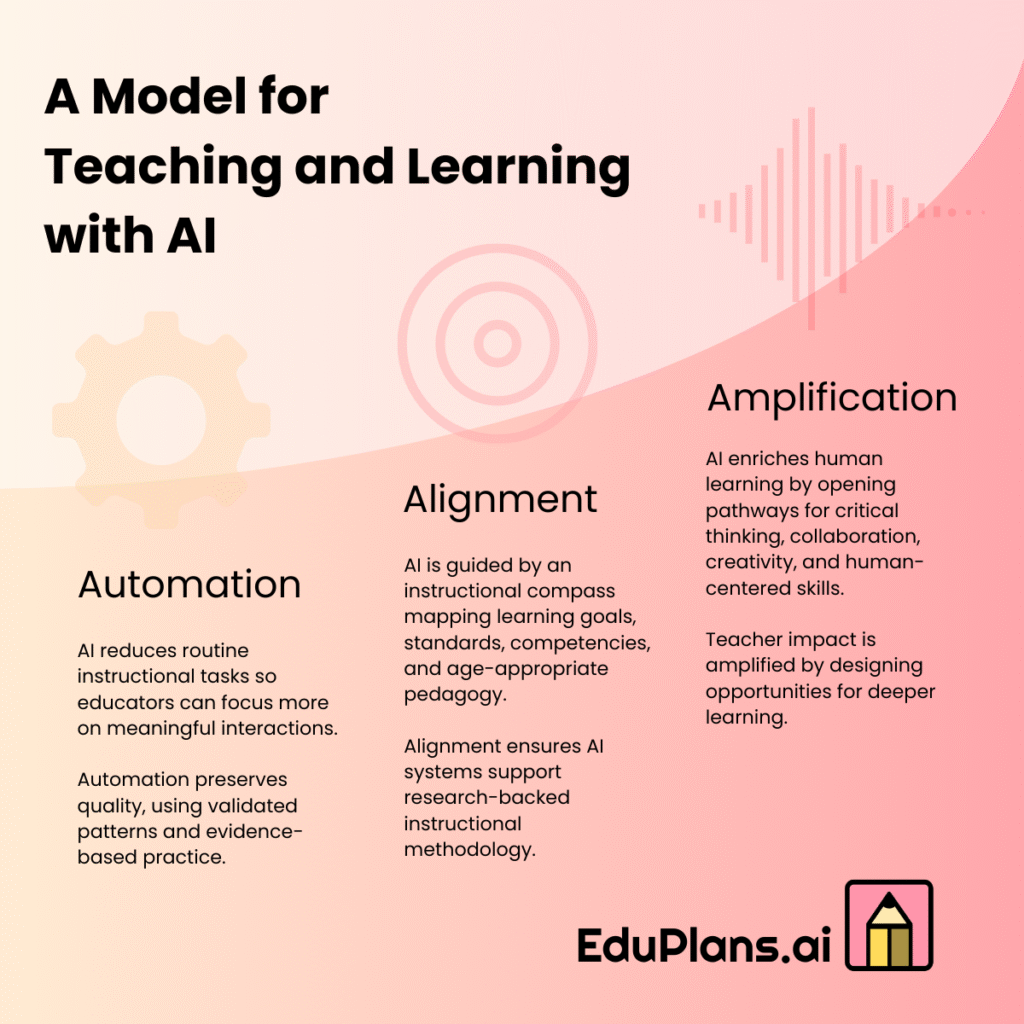
To explain the difference, we use a framework of three levels: Automation, Alignment, and Amplification.
Here is the difference between a tool that writes for you, and an engine that thinks with you.
Level 1: Automation (The Assistant)
“Save me time.”
This is where the vast majority of AI tools sit today. At this level, the system is a highly efficient secretary. It generates worksheets, summaries, and basic quizzes.
The Example:
-
User Prompt: “Create a quiz about the American Civil War.”
-
Level 1 Output: A 10-question multiple-choice quiz asking for dates, battles, and generals.
The Verdict: This is valuable! We know from Cognitive Load Theory that reducing extraneous tasks allows humans to devote more mental energy to complex decision-making (Sweller, 1988). Furthermore, recent studies on teacher workflow show that lowering administrative burden is critical for reducing burnout (McKinsey & Company, 2022). But let’s be honest: a list of dates isn’t deep learning. It’s content generation, devoid of instructional strategy. It solves the “time” problem, but ignores the “learning” problem.
Level 2: Alignment (The Designer)
“Help me plan effectively.”
Level 2 isn’t about just spitting out text; it’s about context.
To achieve this, the EduPlans Engine doesn’t just pass a prompt to an LLM. It intercepts the request and applies pedagogical “guardrails.” It forces the AI to consider the learning goal, the standards, and the students before it generates a single word.
The Example:
-
User Prompt: “Create a quiz about the American Civil War.”
-
Level 2 Output (Powered by Instructional Intelligence): The system pauses. It recognizes that for 8th graders, the standard isn’t memorizing dates but analyzing causes. Instead of a fact quiz, it generates a primary source analysis activity comparing clear excerpts from the North and South. It automatically checks for reading level and suggests scaffolds for English Language Learners, aligning with Universal Design for Learning (UDL) principles (CAST, 2018).
The Verdict: Now we are doing Backward Design—clarifying goals before generating tasks (Wiggins & McTighe, 1998). The AI isn’t guessing; it is aligning the activity to the goal. This ensures the output is educationally valid, resonating with research that learning is most effective when it directly activates prior knowledge and contexts (National Academies of Sciences, Engineering, and Medicine, 2018).
Level 3: Amplification (The Partner)
“Push my thinking.”
At level 3, the AI stops being just a producer and becomes a thought partner. It doesn’t just give you what you asked for; it helps you uncover what the students actually need.
At this level, the Engine uses research on feedback and metacognition to elevate the quality of the teaching itself.
The Example:
-
User Prompt: “I want to teach the Civil War through primary sources.”
-
Level 3 Output: The system generates the materials but then offers a “Pedagogical Nudge.”
-
“This activity is strong, but to support the 6 Cs of deep learning (Fullan et al., 2018), consider adding a ‘What If’ scenario: Ask students how the conflict might have been resolved differently if the Compromise of 1850 had held. Here is a prompt to guide that discussion.”
-
The Verdict: This leverages “Desirable Difficulties”—the concept that deeper learning requires meaningful struggle (Soderstrom & Bjork, 2020). The AI is helping the teacher introduce critical thinking, effectively acting as a mentor that scales best practices to every user on the platform.
Why This Matters
The future of AI in education will not be defined by how quickly we can generate text. It will be defined by how effectively we can support learning.
Level 1 tools are helpful toys. Level 2 and 3 tools are transformative technologies.
By embedding pedagogical reasoning into our platforms, we stop treating AI as a content factory and start treating it as what it should be: a partner that helps every teacher teach their best lesson, every day.
References
CAST. (2018). Universal Design for Learning Guidelines version 3.0. Wakefield, MA: CAST.
EdWeek Research Center. (2023). Teacher Time Use Survey.
Fullan, M., Quinn, J., & McEachen, J. (2018). Deep Learning: Engage the World Change the World. Corwin.
Hattie, J. (2009). Visible Learning: A Synthesis of Over 800 Meta-Analyses Relating to Achievement. Routledge.
McKinsey & Company. (2022). Transforming teacher workflows with AI.
Miao, F., & Holmes, W. (2023). Guidance for generative AI in education and research. UNESCO.
National Academies of Sciences, Engineering, and Medicine. (2018). How People Learn II: Learners, Contexts, and Cultures. The National Academies Press.
Soderstrom, N. C., & Bjork, R. A. (2020). Learning versus performance: An integrative review. Perspectives on Psychological Science, 10(2), 176–199.
Sweller, J. (1988). Cognitive load during problem solving: Effects on learning. Cognitive Science, 12(2), 257-285.
Wiggins, G., & McTighe, J. (1998). Understanding by Design. ASCD.